Small Business Is the Backbone of the Economy — So Why Does It Feel Like It’s About to Break?
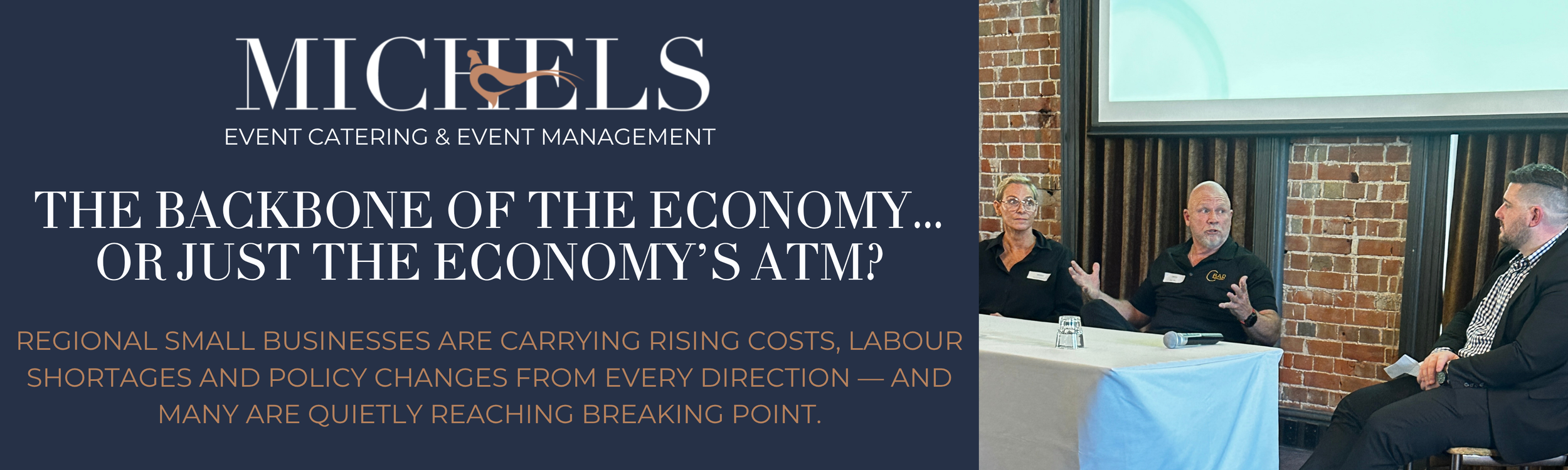
Last Friday, 22 May, the Townsville Chamber of Commerce hosted Minister for Small Business Steve Minnikin and, thanks to the Chamber, I was one of only two businesses invited to share our story.
The Minister delivered a polished, gregarious speech—exactly what you would expect from a seasoned politician. He spoke confidently, held the room’s attention and mentioned his business background to connect with the audience.
But the question I wanted to ask was this:
When politicians say they have owned businesses, were they really in the trenches?
Were they doing payroll at midnight, chasing debtors, covering staff shortages, managing cash flow, and absorbing rising insurance premiums, wages, superannuation, EFTPOS fees, food costs and fuel prices?
Or were they simply reviewing a balance sheet once a quarter and tracking how their investment was performing?
At the event, we were given the Queensland Government’s “Small and Family Business First Action Statement.” The 12-page booklet says Queensland has 495,000 small businesses and estimates there will be more than 615,000 operating across the state by 2032.
To me, those numbers do not automatically signal success.
Politicians love to say that small business is “the backbone of the economy”, but the phrase has become a cliché.
Small business is not treated that way; it feels more like the government’s cash cow.
If small business were truly treated as the backbone of the economy, many of us would not be operating under this level of pressure just to stay afloat.
One initiative highlighted in the Action Statement was a $10 million Small Business Concierge Service—another government department designed to help businesses navigate “support pathways”.
But is that really what small business owners are asking for?
Another portal? Another phone number? Another scripted conversation with someone who has likely never had to make payroll during a quiet trading week?
Because here is what the booklet left out:
• Around 20% of small businesses fail within their first year
• 40–60% fail within the first three years
• 65–70% fail within five years
Those are the statistics small business owners live with every day.
Most small business owners do not need more departments, paperwork or “pathways to support”.
They need pressure taken off: lower costs, less red tape and fairer tax structures.
They need wage systems that do not require a degree in employment law to interpret.
They need policies that genuinely reflect the realities of running a business in 2026.
As my offsider noted on the day, the wage disparity debate also feels disconnected from operational reality.
An inexperienced 15-year-old waiter who can run three tables, lives at home and has few responsibilities can now cost an employer almost as much as an experienced 25-year-old hospitality worker who can run six tables, manage pressure, solve problems and keep service moving.
So where is the incentive for businesses to take a chance on young people if they are expected to pay almost the same rate for half the productivity?
Are we creating a generation of young people with fewer practical skills because businesses can no longer afford the training burden?
The same issue applies to EFTPOS transaction changes.
Businesses are being pushed ever closer to a cashless economy while also being expected to absorb tens of thousands of dollars in merchant fees each year so customers can earn frequent flyer points and loyalty rewards.
Paying by credit card is convenience businesses offer customers, and customers can still choose to pay cash.
So why should businesses be expected to fully subsidise that convenience?
And to make matters worse, hospitality businesses pay GST on revenue they never actually retain because merchant fees are deducted before the money reaches their account.
For catering and food distribution businesses, the pressure is no longer coming from one direction, it is coming from everywhere at once.
The list is familiar: rising wages, higher operating costs, staffing shortages and compliance demands, all piling on at once. Individually, most of these challenges are manageable. Together, they create constant pressure on margins and cash flow.
In regional Australia, the challenge is even greater.
We compete for a limited pool of skilled workers across multiple industries while trying to maintain service standards, train new staff and remain commercially viable.
For labour-intensive businesses such as catering and food distribution, staff consistency is critical. When stability disappears, productivity drops, service quality suffers and the customer experience declines.
There is a growing gap between policy and operational reality, no matter how well-intentioned these changes may be.
It increasingly feels as though small business is expected to absorb every economic shift while remaining competitive, profitable and resilient all at once.
But when small business carries too much of that load, the impact is not confined to the business owner, it flows through the broader economy.
At some point, the question is no longer how much more small business can absorb.
It is how much more it should be expected to absorb.